


Most advice about email follow-ups focuses on simple rules: wait three days, send a reminder next week, or avoid following up too soon.
But those rules ignore something important: what the recipient actually does after your email arrives.
Using MailTracker, we analyzed 5,324 one-to-one emails, including open timestamps, reopen behavior, and reply timing.
This allowed us to see not just when emails were sent, but when people returned to them, reconsidered them, and eventually replied.
What we found suggests the best follow-up timing isn’t based on fixed schedules at all. It’s based on engagement signals most people never look at.
TL;DR: Follow-Up Timing Based on Real Data
Based on our analysis of 5,324 emails:
- If the email was opened → wait 1 business day
- If opened multiple times → follow up the same day
- If reopened after days → follow up within hours
- If never opened → follow up after 1–2 days
The best follow-up timing depends on recipient behavior, not fixed rules.
How We Gathered This Data
This analysis is based on 5,324 real one-to-one emails sent through Gmail and tracked with MailTracker between 2025 and 2026.
These were not newsletter sends, automated sequences, or marketing campaigns.
Each email in the dataset was sent from one real person to another, which makes this study a closer reflection of everyday email behavior.
This study is part of an ongoing series of email behavior analyses we run using MailTracker.
We recently published a separate study on the best time to send emails, using the same dataset to analyze which days and hours generate the most opens and replies.
This article looks deeper into what happens after the email lands.
For each email, we tracked:
- Time to first open: how many minutes, hours, or days passed between send and the first open
- Reopen count: how many times the recipient returned to the same email
- Reply timing: whether a reply came, and how long after the first open
- Open rate: across the full dataset, 90.71% of emails were opened, meaning 9.29% were never opened at all
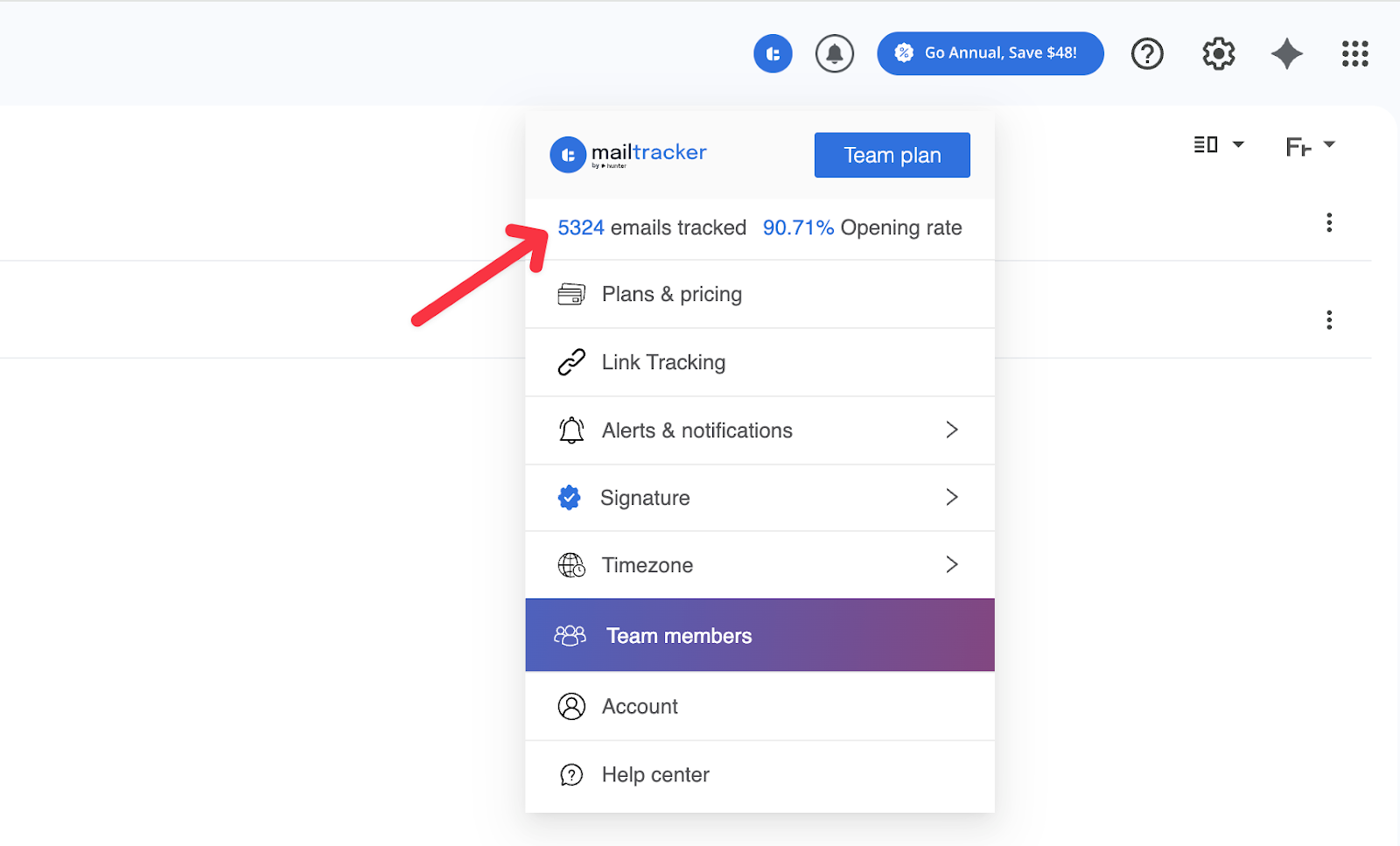
Together, these signals let us analyze not just whether an email was opened, but how recipients engaged with it over time.
Most Emails Are Opened Within the First Hour
Of all the emails in our dataset that were opened, 70% were opened within the first 60 minutes.
This means that in most cases, whether your email gets seen or ignored is decided within the first hour.
Here’s how email open timing is distributed across the dataset:
To make this more concrete, here are a few real examples from the dataset:
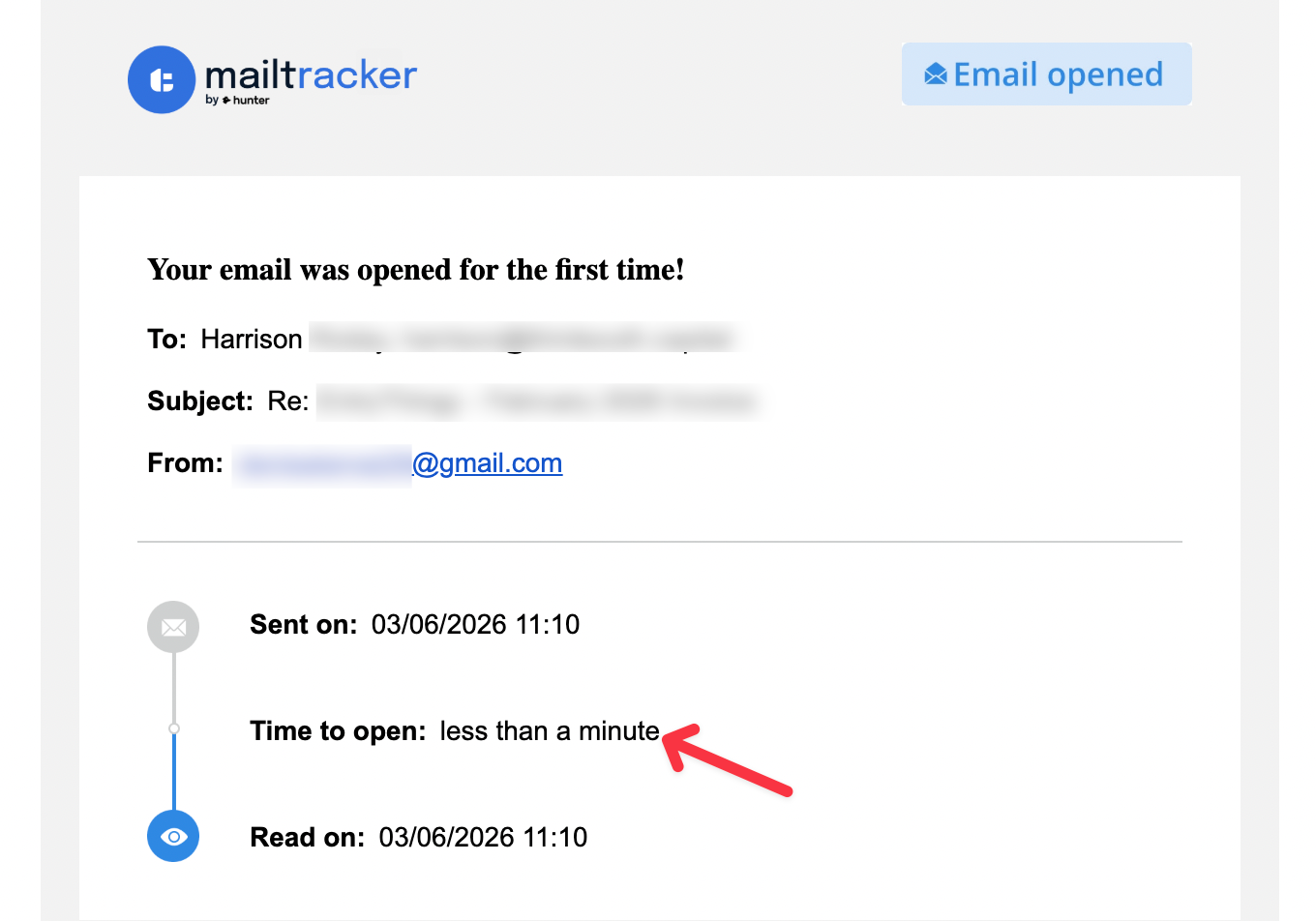
Take this email, sent on March 6th at 11:10 AM, opened at 11:10 AM. Time to open: less than a minute.
The recipient saw the email almost immediately after it was sent.
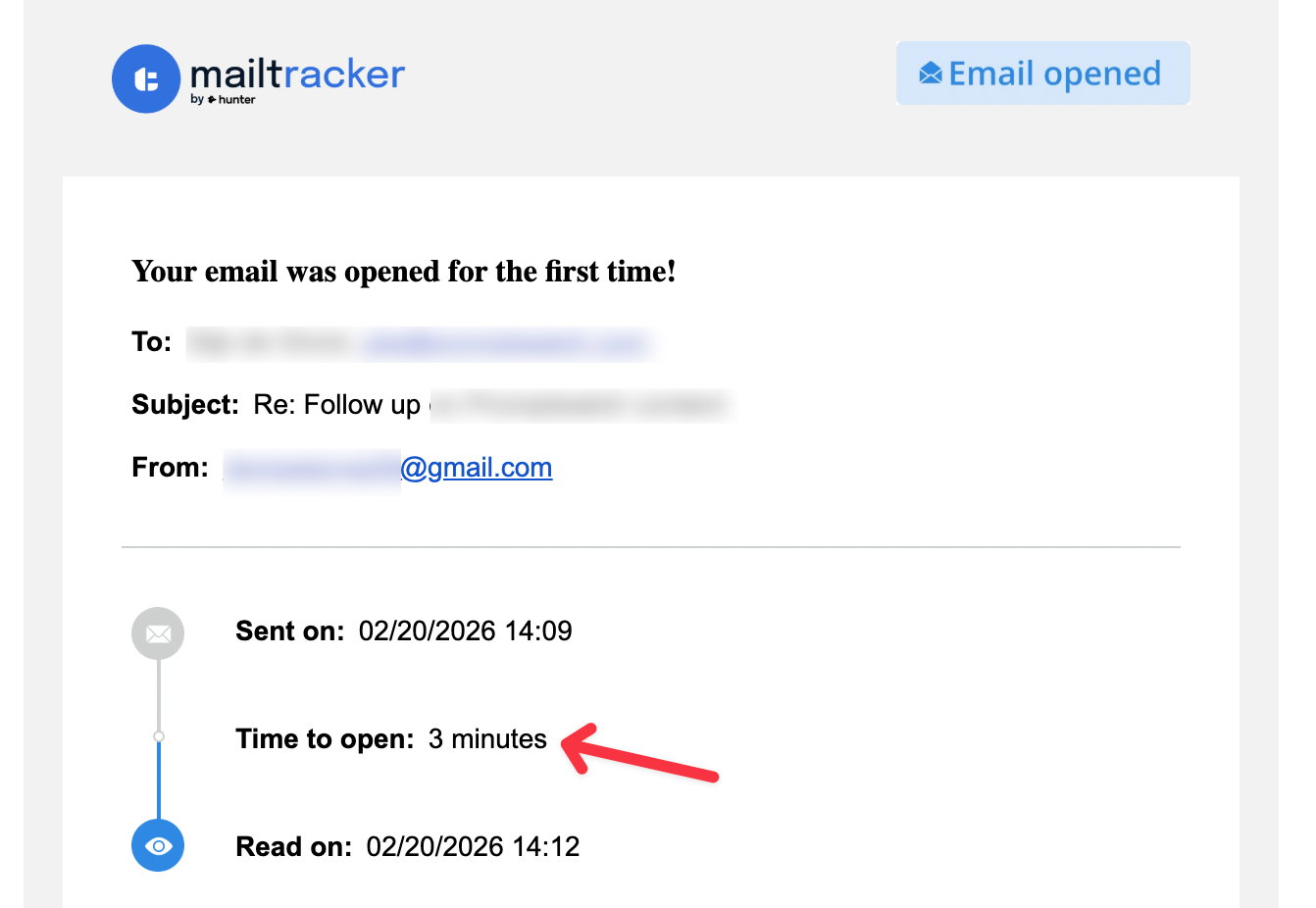
Here’s another example. Sent February 20th at 2:09 PM, opened three minutes later.
The recipient didn’t wait until later in the day, they saw the email arrive and opened it within minutes.
And this third one is particularly interesting, because it's two signals in one. The email was opened within less than a minute of being sent on March 2nd.
Then 11 days of silence. Then reopened on March 13th at 12:14 PM. We'll come back to what that second open means in a moment.
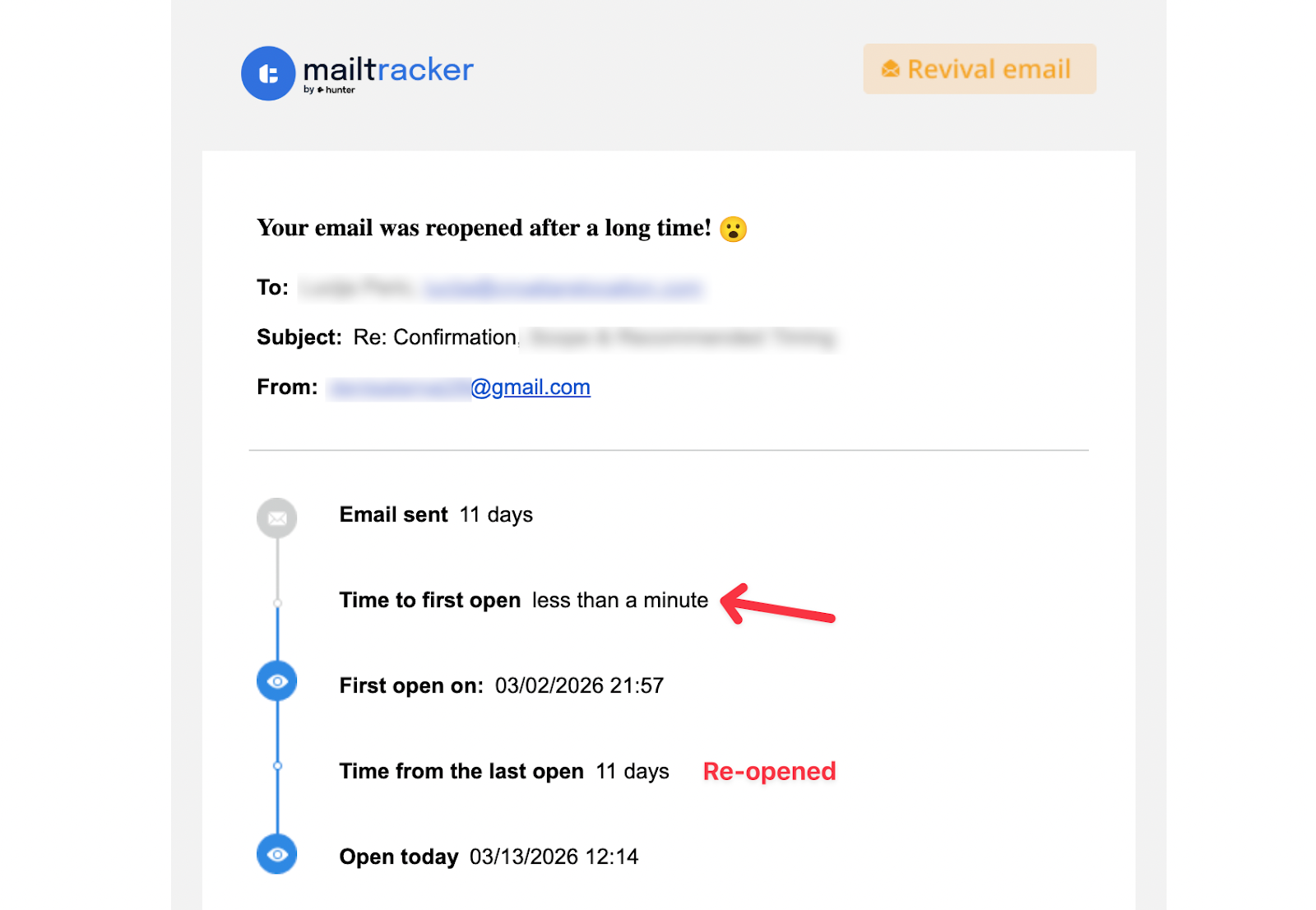
Every one of these is a different email, a different sender, a different recipient. The pattern holds every time: when someone is active and your email arrives, they open it fast.
Why do emails get opened so fast today?
Today, email is almost always visible.
People check their inbox on phones, laptops, and multiple devices throughout the day. That means many emails are seen the moment they arrive.
Mobile devices alone account for a large share of email opens globally, which helps explain why so many emails in our dataset were opened within the first hour.
But there’s an important difference between opening fast and replying fast.
A fast open usually signals availability or inbox visibility. It does not automatically signal intent.
That’s why open speed tells you whether your email was seen, but reopen behavior is often a much stronger signal when you’re deciding whether to follow up.
If your email was opened within the first hour but no reply came, the best move is usually to wait one full business day before following up.
The ~20%: Opened Late, But Still Opened
About 20% of emails in our dataset were opened, but not within the first hour.
These emails follow three distinct patterns, each with a different implication for how and when you should follow up.
Opened the same day, just later.
The recipient was in a meeting, away from their phone, or processing their inbox in batches. They saw the email later in the day.
Reply rates here are still relatively strong, especially if your email has a clear ask and requires minimal effort to respond.
Opened the next day or within three days.
The email was likely buried overnight or over the weekend. By the time it resurfaces, it’s competing with everything that arrived after it.
The recipient reads it, but the context has cooled.
Reply rates drop significantly at this stage, which is why a well-timed follow-up before this happens can make a meaningful difference.
Reopened after days or weeks of silence.
This is what we at MailTracker call a “Revival email.” The recipient went back and found your email on purpose. Out of everything in this dataset, this is the strongest engagement signal.
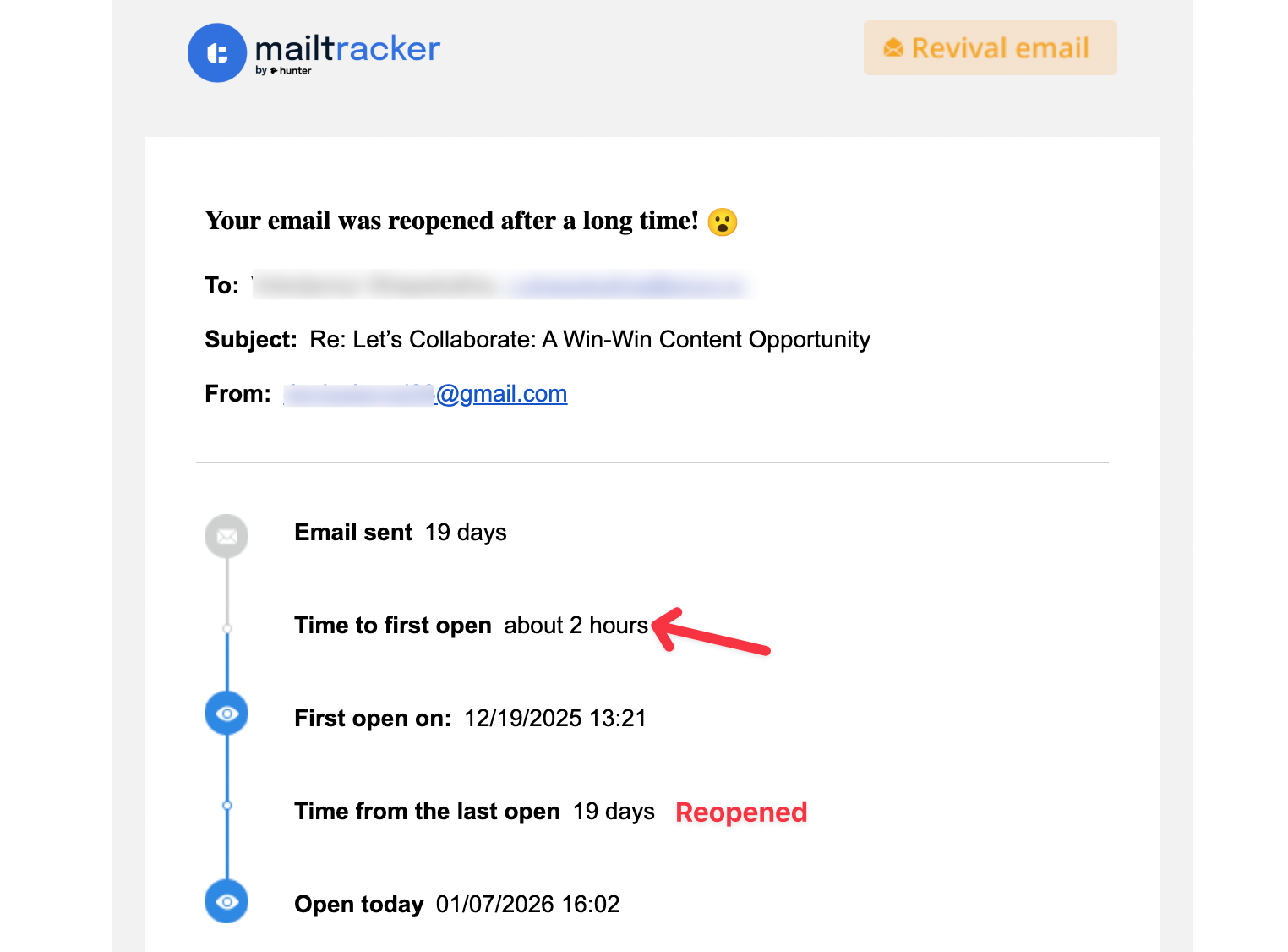
Think about what a revival actually means.
This person saw your email, didn’t act on it, and then returned to it days or weeks later.
That’s not passive behavior. That’s active reconsideration.
Something changed (a conversation, a deadline, or a shift in priorities) and your email became relevant again.
This means if your email is reopened after a period of silence, follow up within hours, not days.
What This Means for Follow-Up Timing
These three patterns show that follow-up timing shouldn’t be fixed. It should adapt to how the recipient interacts with your email.
- Opened later the same day → follow up the next day
- Opened after 1–3 days → follow up before it gets buried further
- Reopened after silence → follow up immediately
The closer your follow-up matches real behavior, the higher your chances of getting a reply.
If you want a deeper breakdown, you can read our full guide on follow-up email strategy based on opens and clicks.
The 9.29%: Emails That Were Never Opened
Across our dataset, 90.71% of emails were opened. That means 9.29% were never opened at all, nearly 1 in 10 emails that were sent but never seen.
This isn’t usually about disinterest. Most of the time, it’s about timing.
An email arrives during a busy moment, gets quickly skimmed past, and then disappears under everything that comes after it.
By the time the recipient checks their inbox again, your email is no longer visible.
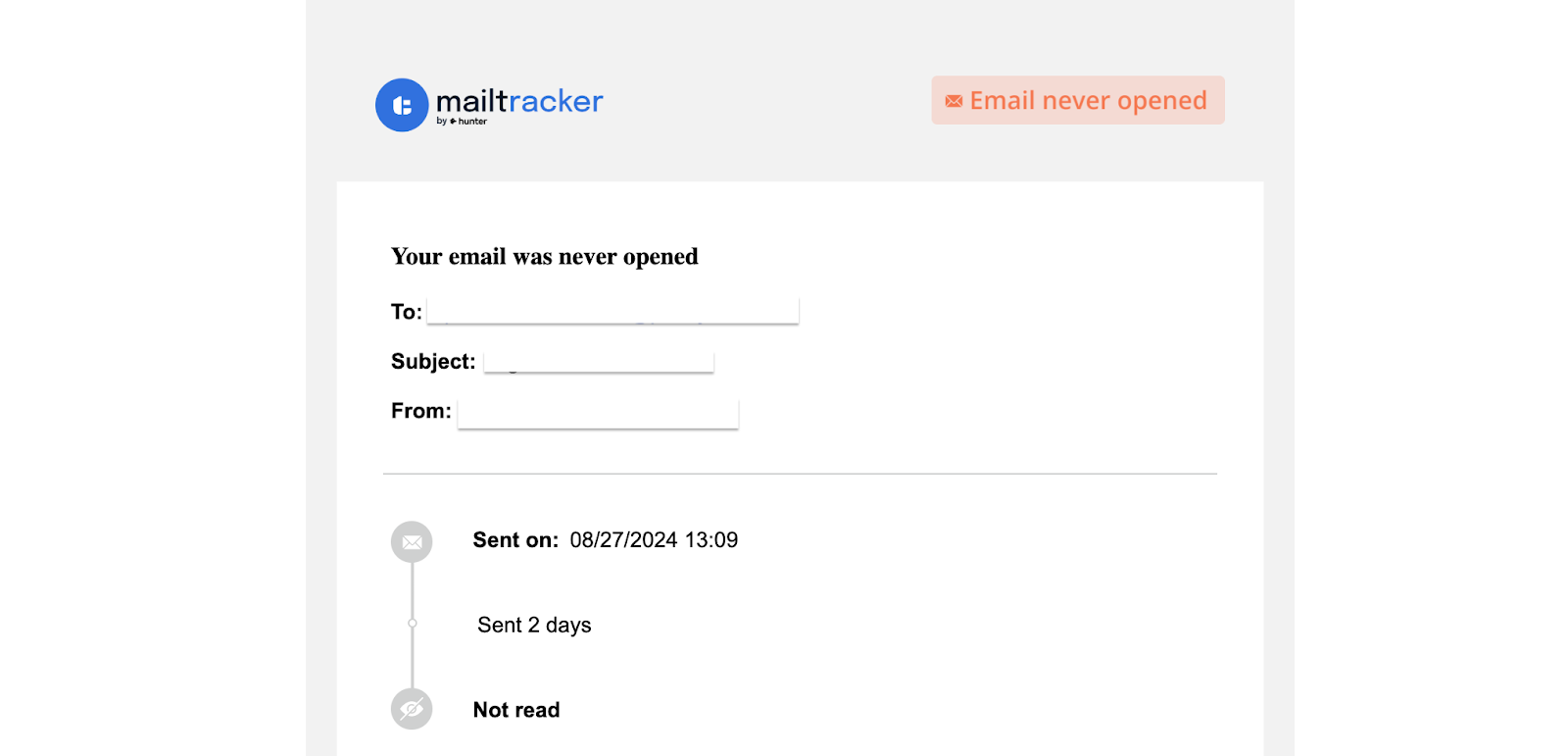
For most senders, this is completely invisible.
You assume the person saw your email and chose not to reply. So you either follow up too late, or you don’t follow up at all because you’re treating a visibility problem as a rejection problem.
That distinction matters.
A never-opened email should not be treated the same way as an opened one. If the recipient never saw it, the right move is not to push harder. It’s to change the timing.
If your original email was sent in the afternoon, follow up in the morning. If it was sent at the end of the week, follow up early next week. If it got buried, resend it when the inbox is fresh.
The two-day rule that actually comes from data
In our dataset, emails that hadn't been opened within two days almost never got opened without a follow-up. Two days is the natural “shelf life” of an unseen email before it gets permanently buried.
This is why MailTracker suggests following up within two days on emails that haven't been opened.
You can set a follow-up reminder directly inside Gmail (in 2 days, in 5 days, in 7 days, or a custom date) so you never have to manually track which emails need a nudge.
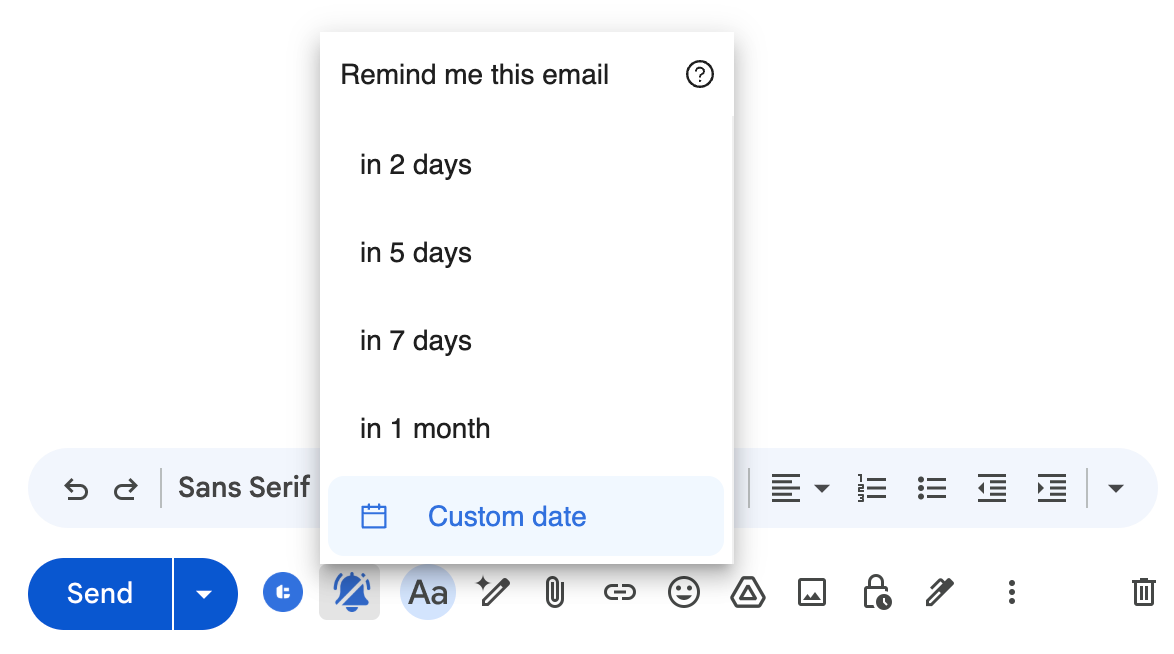
A never-opened email is not a rejection. It’s a missed timing window. Set a reminder, change the send time, and try again. You're not being pushy, you're solving a visibility problem.
FAQs
When do most people open emails?
Based on our analysis of 5,324 emails, 70% of emails are opened within the first 60 minutes. This means most recipients see your email shortly after it arrives, especially on mobile devices.
Is it okay to follow up on the same day?
Yes, but only in specific situations. If your email was opened multiple times or reopened after a period of silence, same-day follow-up is effective. If it was opened once with no reply, it’s better to wait one business day.
What does it mean if someone opens your email multiple times?
Multiple opens usually indicate interest or intent. The recipient may be reviewing your message, considering a response, or sharing it internally. This is often a strong signal to follow up sooner.
What does it mean if an email is reopened after days or weeks?
This is one of the strongest engagement signals. It means the recipient actively came back to your email, often because something changed (a deadline, a conversation, or new context). In this case, you should follow up within hours.
What if my email was never opened?
A never-opened email is usually a visibility issue, not a rejection. In our dataset, emails that weren’t opened within two days were unlikely to be opened later without a follow-up. The best approach is to resend at a different time when the recipient is more likely to see it.
How many times should you follow up?
In most cases, one well-timed follow-up is enough. The data shows that timing based on behavior (opens, reopens, no opens) is more effective than sending multiple follow-ups on a fixed schedule.

